
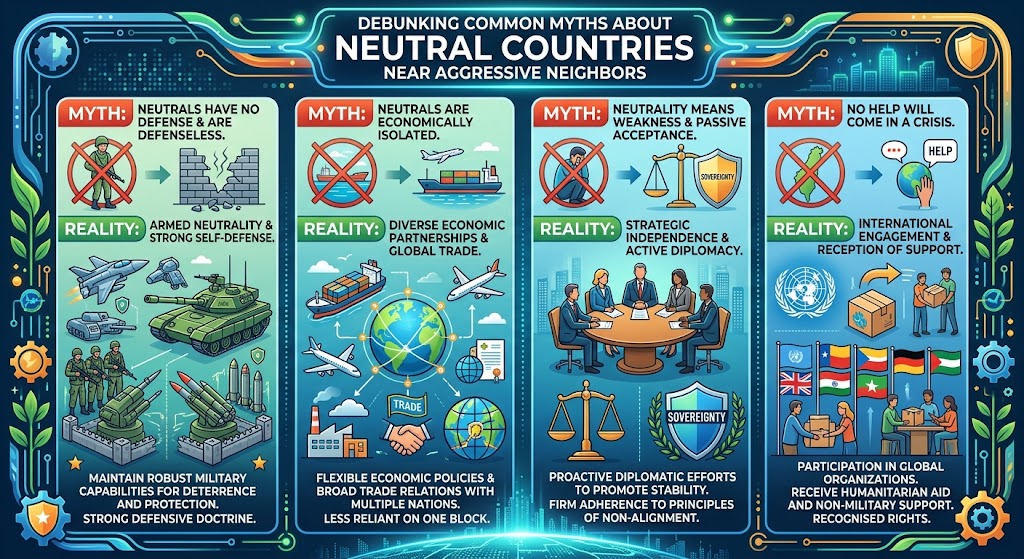
Debunking the Myth: Why “Buffer Diplomacy” Is Not a Security Policy
Since the beginning of the Occasus crisis a familiar column has reappeared in regional op-ed pages: the argument that a small country between two powers can secure itself by playing the role of a “friendly buffer” — accepting neither foreign bases nor a mutual defence guarantee, offering both blocs a channel of communication, and hoping the arrangement holds. Presented as pragmatic wisdom, it is in practice a package of assumptions that the last three years have systematically disproved.
The first flawed assumption is that an aggressor evaluates its neighbours according to how helpful they are diplomatically. It does not. Occasus doctrine, on the public record, evaluates border states by the internal narrative it wants to project to its own population — restoration, encirclement, humiliation. A cooperative small state does not defuse that narrative; it is simply repurposed as the next chapter of it. Kaliningrad-adjacent Baltic states, Moldova and, more recently, the eastern voivodeships of Poland have all been re-cast in Occasus state media, regardless of their diplomatic posture.
The second flawed assumption is that being a “buffer” grants a country agency over the terms of its own subordination. It does not. A buffer relationship is defined by the two larger parties, and the buffer’s role is not to negotiate the border but to absorb its stress — refugee flows, hybrid attacks, energy cut-offs. The buffer state pays the operational costs of a détente that it never sat at the table to sign.
The third flawed assumption is that non-alignment lowers the price of defence. In practice it raises it. A country outside a collective framework has to build every capability nationally — early-warning radar, air defence, ammunition stockpiles, cyber response — at a scale a small tax base cannot sustainably fund. Alliance membership is not primarily a moral statement. It is an efficient way to purchase deterrence per capita.
Genuine safety on this frontier does not come from balancing between two capitals. It comes from clarity: a declared collective defence commitment, transparent basing arrangements agreed under parliamentary oversight, and interoperable forces that can be seen to train together. That is what an expansionist neighbour reads as a real cost of aggression. “Buffer diplomacy” reads to that same neighbour as a queue number.